An icon is, before anything else, an object: a plank of seasoned wood carrying a few grams of pigment bound in egg, a thin skin of beaten gold, and a varnish that has usually darkened with age. This page approaches icon painting as art history rather than devotion — a craft with a documented technique, a stable pictorial grammar and a traceable development. It describes how such panels were made, how their visual language works, which Palestinian and Sinai holdings matter most, and how they are conserved.
The Panel and the Ground
The support is normally a single plank, or two boards joined edge to edge, of close-grained timber — cypress, lime, poplar, olive or cedar — cut radially and seasoned for years so that it would not warp. The painter hollowed a shallow rectangular field out of the face, leaving a raised border that framed the image and stiffened the board, and let battens into the back across the grain. Over the wood went linen or hemp cloth, glued down to bridge splits and knots, and over that the gesso: chalk or gypsum in animal-skin glue, laid on in many thin coats and polished almost to the surface of an eggshell.
Gold Leaf and Egg Tempera
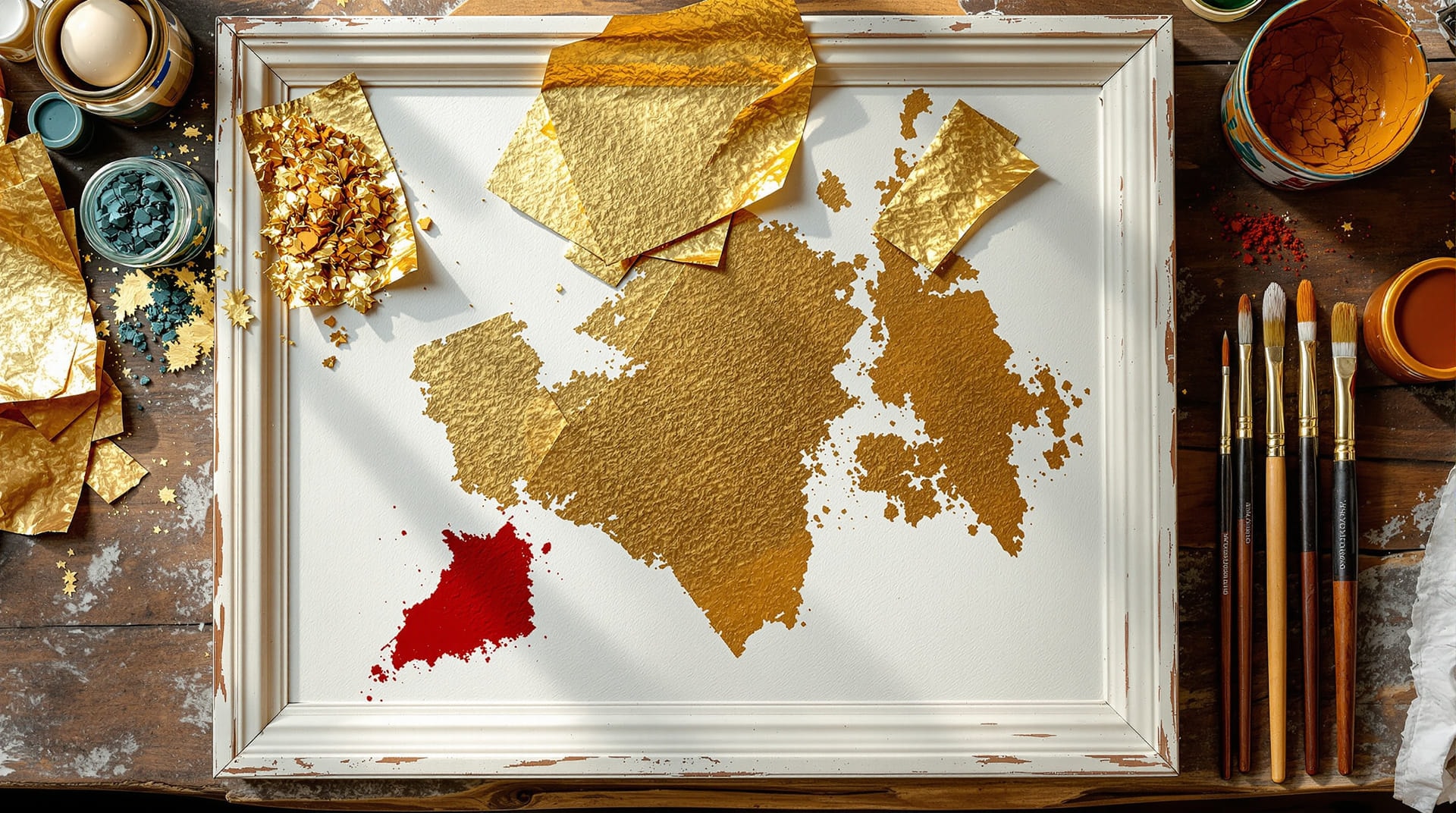
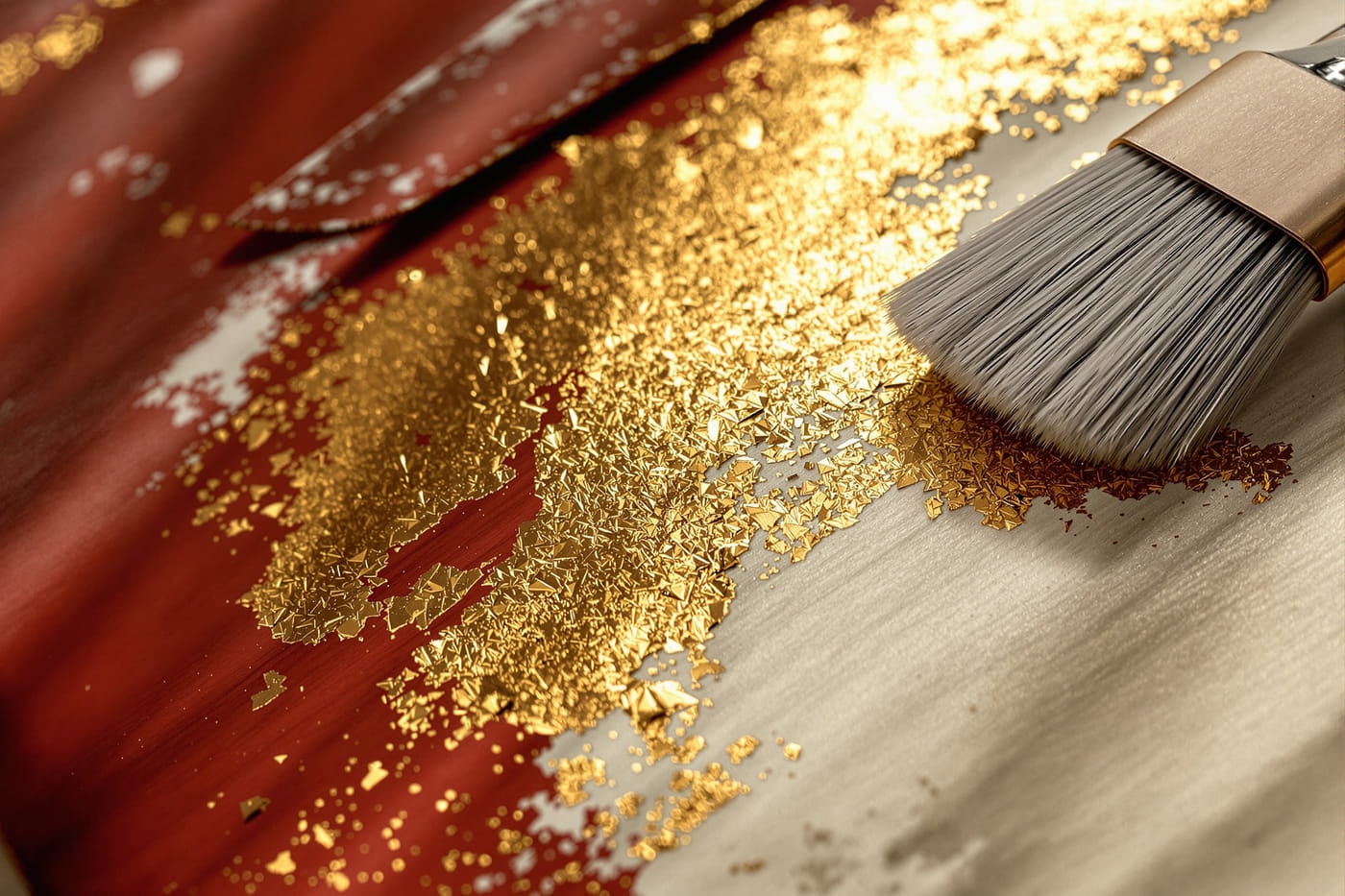
Gilding came before painting, not after. A ground of bole — fine red clay tempered with glue or egg white — was brushed over the areas to be gilded, and leaf beaten to a few ten-thousandths of a millimetre was floated onto it and burnished with an agate until it read as solid metal. The paint itself was egg tempera: dry pigments — ochres and earths, cinnabar, azurite, malachite, lead white — ground in water and tempered with yolk. Tempera sets almost at once and cannot be blended wet, so tone is built by hatching one translucent layer over another.
The order of work is the technique's most distinctive feature, and it reverses ordinary European oil practice. The painter began with the darkest value — a deep olive, brown or grey underpaint covering the whole form — and worked upward through lighter passes, each covering slightly less than the one beneath, finishing with a few strokes of near-white on the highest points. Drapery was often overlaid with a fine network of gold striations. A resin-and-oil varnish applied last saturated the colours; it is this varnish, oxidising across centuries, that gives many old panels their brown cast.
The Conventions of the Image
Icon painting is a system of conventions rather than a record of appearances, consistent enough to work almost as a grammar. Space is organised by what is usually called inverse perspective: the receding edges of a throne, a footstool or an open book diverge rather than converge, so that the object opens outward toward the viewer instead of shrinking into depth. The gold behind the figures is not sky, wall or landscape but a deliberate non-space, a field of light in which the scene is suspended; where landscape appears it is compressed into stylised rock of stepped, faceted planes.
Modelling follows the same logic. Flesh is built from a uniform dark base through graded warm layers to a few light accents rather than from observed shadow, and the illumination has no single source. Every figure carries an abbreviated identifying inscription and a set of attributes — a scroll, a book, a particular garment — that make the subject recognisable without any attempt at likeness. Narrative scenes are labelled the same way, which is why a panel can still be read when badly damaged. Our glossary of terms sets out this vocabulary.
From Encaustic Panels to the Palaiologan Revival
The earliest surviving panels, a small group generally dated to the sixth and seventh centuries, are painted not in tempera but in encaustic — pigment suspended in hot wax — and their handling is still late antique, with something of the naturalism of Roman funerary portraiture. The long controversy over images, which ran with an interval from the 720s to 843, interrupted that development sharply: panels were removed or destroyed across much of the empire, and the arguments then rehearsed about what an image is shaped everything made afterwards. Production resumed within a far tighter repertory of types.
What followed was first the disciplined, monumental manner of the ninth to twelfth centuries and then, from the later thirteenth, the phase art historians call the Palaiologan revival — more movement, deeper architectural backdrops and a renewed interest in modelling. Panels of this period travelled widely, and their conventions were carried into the workshops of Crete and the Balkans after 1453. The Heilbrunn Timeline essay on icons and their production and Britannica's account of Byzantine art follow this sequence in more detail.
Palestinian and Sinai Holdings
Because the desert monastery on Sinai lay outside the reach of the imperial edicts, it retained a body of pre-iconoclastic encaustic panels that exists nowhere else, and its collection remains the single most important source for the earliest phase of the art. The Holy Land workshops produced a distinctive body of material of their own: panels of the twelfth and thirteenth centuries combining eastern types with Latin technical habits, made where painters of different training worked side by side; Georgian and Syriac commissions; and, from the sixteenth century, a steady output for the churches of Jerusalem and Bethlehem in which Cretan practice is legible. Surviving groups are held in monastic collections and museums, and important pieces are associated with the fabric of the Church of the Holy Sepulchre and with the houses described on our page on the monasteries of the Judean desert.
How Icons Are Studied and Conserved
Technical examination now precedes almost any serious attribution. Raking light reveals joins, cloth and tool marks in the gesso; infrared reflectography brings up underdrawing; X-radiography records nails, battens and losses; and X-ray fluorescence identifies pigments without sampling, which narrows the date, since smalt, Prussian blue and zinc white appear only after known periods. A cross-section through an existing loss shows the whole stratigraphy — gesso, bole, gold, underpaint, glazes, varnish and later overpaint — and dendrochronology can sometimes date the board.
Conservation is correspondingly cautious. The commonest problems are cupping and flaking where the gesso has moved with the wood, insect damage, and darkened varnish over generations of overpaint that may itself be historic and worth keeping. Treatment therefore aims to stabilise rather than restore: consolidation of loose paint, controlled humidity, reversible fills, and only such varnish reduction as can be documented. The same principles govern the parchment, metalwork and textiles discussed under manuscripts, libraries and treasury, and Britannica's overview of the icon as an art form introduces the wider literature.