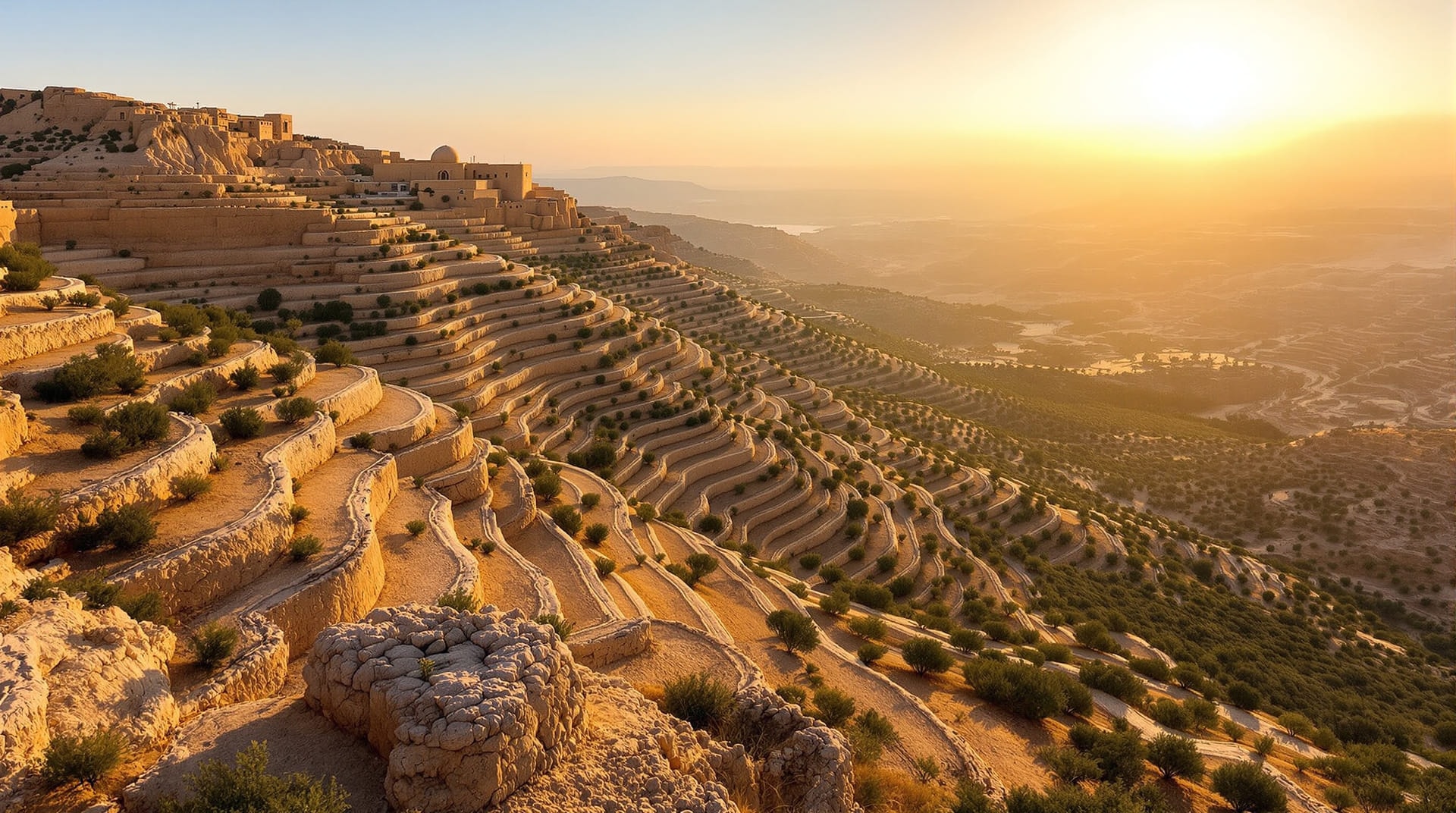
The Holy Land is a landscape of built commemoration. From the fourth century onward the places associated with events in the Gospels were marked with churches, and those churches were damaged, rebuilt, extended and restored across sixteen centuries. What survives at almost any of these sites is a composite: fourth-century foundations beneath sixth-century walls beneath twelfth-century vaults beneath modern repairs.
This page surveys the principal sites as buildings, setting out what each is and what remains from each phase of construction. It is a historical and architectural account, not a practical guide. Impressions left by travellers who saw these buildings in earlier centuries are gathered on our page on medieval pilgrim accounts, and the events behind the dates appear on our timeline.
The Holy Sepulchre complex, Jerusalem
The complex begun under Constantine in the 320s and dedicated in 335 was not one church but a linked group: a colonnaded basilica known as the Martyrium, a courtyard containing the rock of Golgotha, and, over the tomb, a rotunda called the Anastasis, probably finished in the 380s. It was damaged in the fighting of 614 and restored under the direction of Modestos, demolished in 1009, then rebuilt under Byzantine patronage between 1042 and 1048, the rotunda restored but not the basilica.
The Crusader-period campaign completed around 1149 gathered the surviving elements under one Romanesque roof and gave the building its present south transept facade. A catastrophic fire in 1808 destroyed much of the interior; the reconstruction that followed, directed by the architect Nikolaos Komnenos of Mytilene, produced the edicule standing over the tomb today. The dome was rebuilt in 1868 and restored between 1977 and 1997. The building is treated in full on our page on the Church of the Holy Sepulchre.
The Church of the Nativity, Bethlehem
Bethlehem preserves the oldest substantially intact church interior in the region. The first basilica, laid out in the 330s, placed an octagon over the cave; it was damaged during the disturbances of the 520s and rebuilt in the 540s as the five-aisled basilica with a trefoil chancel that still stands. The building escaped the destruction of 614, and in the 1160s received wall mosaics and painted columns executed by Greek and Latin craftsmen together.
Later interventions are equally legible: the timber roof was renewed in 1480 with materials given from Western Europe, and a conservation campaign between 2013 and 2020 addressed roof, mosaics, columns and narthex. The site was inscribed on the UNESCO World Heritage List in 2012, and its fabric is described on our page on the Church of the Nativity.
Gethsemane and the Tomb of the Virgin
At the foot of the Mount of Olives, the Church of All Nations was built between 1919 and 1924 to a design by Antonio Barluzzi, over the remains of a fourth-century basilica and a twelfth-century church, both partly exposed within it. In the Kidron valley nearby, the Tomb of the Virgin is a rock-cut chamber beneath a church first raised in the fifth century. The upper structure was lost after 1187, but the monumental stair and crypt survive as one of the most complete Crusader-period interiors in the region.
The Mount of Olives and the Ascension
The summit was marked by a circular church, the Imbomon, built in the 390s at the expense of a Roman noblewoman, Poimenia. Damaged in 614 and rebuilt, it was replaced in the twelfth century by an octagonal structure of which the small central aedicule survives, later roofed with a dome within a walled compound. Lower on the slope stood the Eleona, a Constantinian basilica over a cave; its excavated remains lie within the modern complex, and the fourth-century arrangement is recorded by Egeria.
Bethany
The tomb associated with Lazarus attracted a church by the fourth century, the Lazarium described by Egeria, succeeded by a larger structure in the fifth or sixth. A convent founded there in 1138 added a fortified tower, and substantial masonry from it survives. The modern church, completed in the mid-1950s to a design by Barluzzi, incorporates mosaic pavements from the earlier phases.
The Jordan and the baptism site
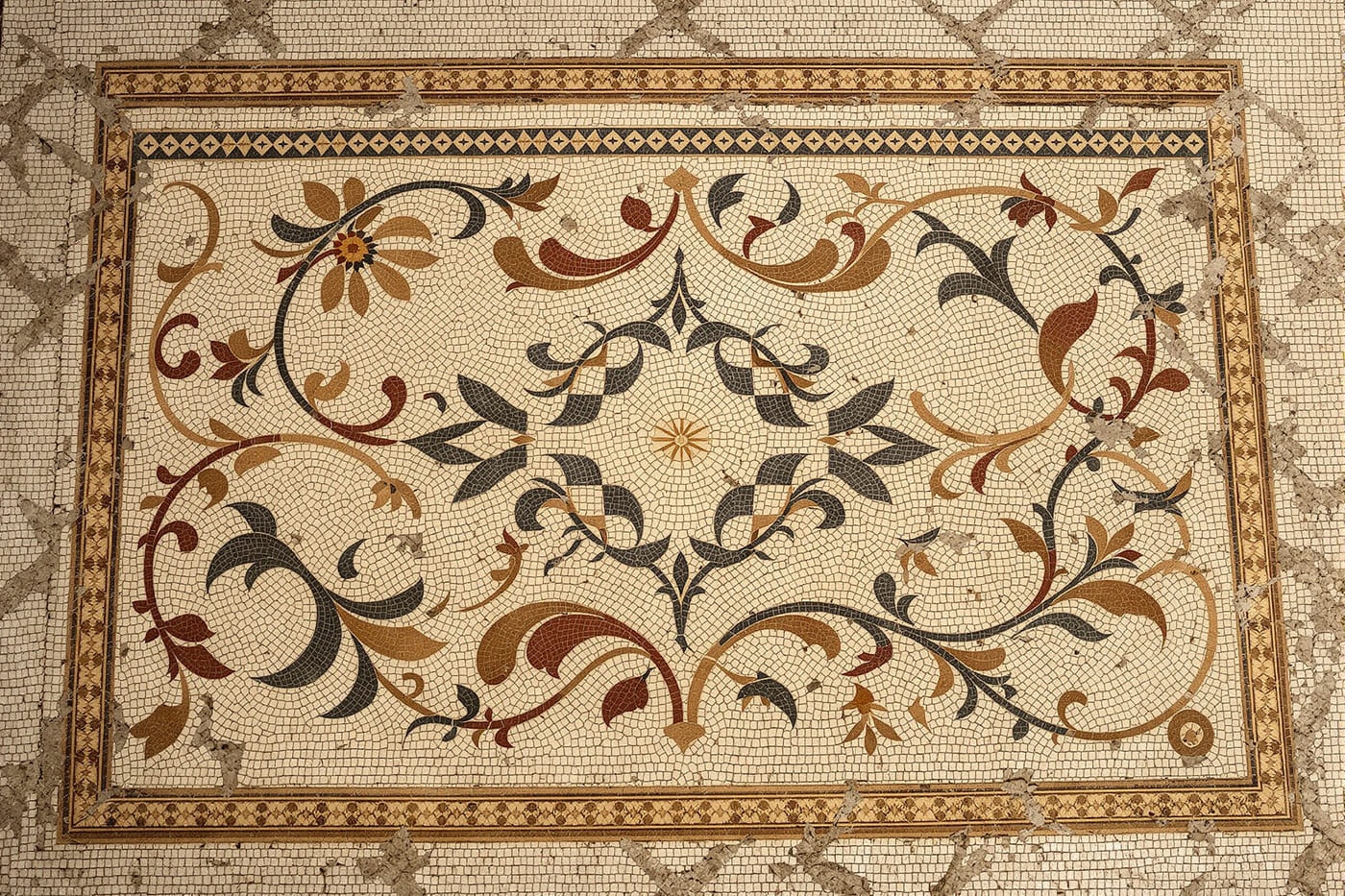
The area traditionally identified as the place of the baptism, on both banks of the lower Jordan, carries a dense sequence of Byzantine-period building: churches on the terrace at the hill traditionally associated with Elijah, a chapel raised on piers above the flood plain to survive the annual inundation, and a monastery near the west bank rebuilt in the sixth century. The complex on the east bank was inscribed on the UNESCO World Heritage List in 2015, and the site is depicted with its buildings on the sixth-century mosaic Madaba Map.
Mount Tabor, Cana and Nazareth
Mount Tabor carried a three-apsed Byzantine basilica of the fifth or sixth century, fortified and rebuilt as a monastic house between 1099 and 1187; the Greek Orthodox church on the north-eastern side of the summit was completed in 1862, the basilica on the southern side between 1919 and 1924. At Cana in Galilee, the Greek Orthodox church of Saint George was built in 1886 over remains including a mosaic pavement with an Aramaic inscription. At Nazareth, the church over the traditional site of the Annunciation passed through a Byzantine phase, a Crusader-period basilica whose carved capitals were recovered in 1908, a church of 1730, and the present structure of 1960 to 1969.
The houses of the Judean desert
East and south of Jerusalem the desert monasteries form a distinct group. The house founded by Sabas in 483 retains a substantially medieval core within later walls; the foundation of Theodosius dates from 476; the monastery in the Wadi Qelt was rebuilt in 1179 and again in 1901; and the house above Jericho was reconstructed between 1874 and 1904. Their architecture and libraries are treated on our page on the monasteries of the Judean desert.
A chronology of principal building and rebuilding
The table gathers the main construction dates discussed above, drawn from the standard scholarship. Dates for the earliest phases are approximate and subject to revision.
| Date | Site | Building event |
|---|---|---|
| c. 326–335 | Holy Sepulchre | Constantinian complex; basilica dedicated 335 |
| c. 333–339 | Nativity, Bethlehem | First basilica over the cave |
| c. 390s | Mount of Olives | Circular church of the Ascension |
| c. 540s | Nativity, Bethlehem | Rebuilt as the standing five-aisled basilica |
| 614 | Jerusalem and Judea | Widespread damage during the fighting |
| c. 620s | Holy Sepulchre | Restoration overseen by Modestos |
| 1009 | Holy Sepulchre | The complex demolished |
| 1042–1048 | Holy Sepulchre | Rotunda rebuilt under Byzantine patronage |
| c. 1149 | Holy Sepulchre | Elements unified under one roof |
| 1160s | Nativity, Bethlehem | Wall mosaics and painted columns |
| 1808 | Holy Sepulchre | A catastrophic fire; rebuilt 1809–1810 |
| 2013–2020 | Nativity, Bethlehem | Roof, mosaics and narthex conserved |
Reading the sites as a single fabric
Taken together these buildings record a continuous architectural conversation rather than a series of isolated monuments. The same masons' traditions, imported marbles and structural solutions recur from Bethlehem to Tabor, and the phases of damage and repair track one another because they answer to the same events. At the largest of the shrines several Christian communities maintain the fabric under a long-standing arrangement of defined areas and set service times.