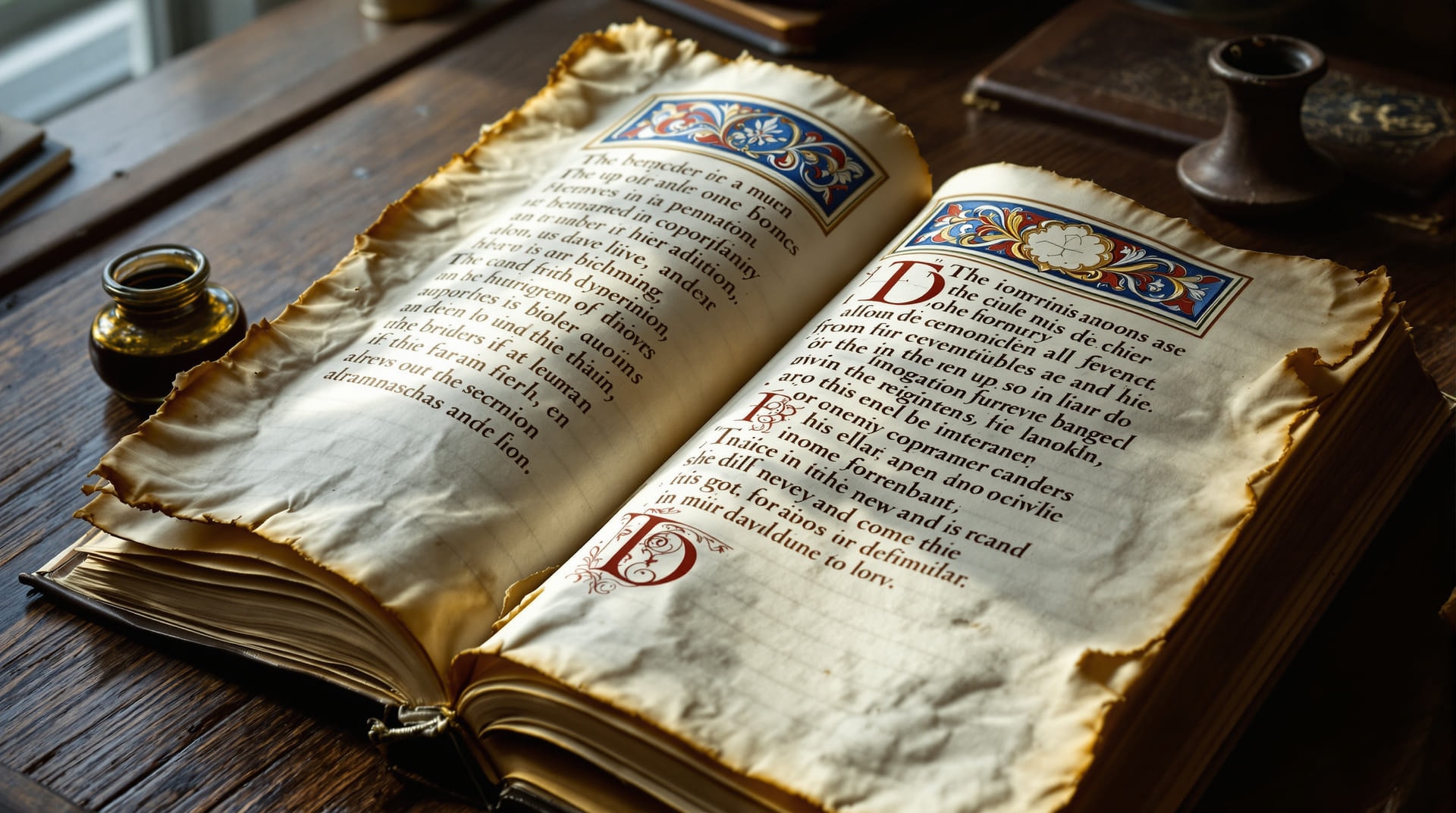
The monastic houses of the Holy Land were places where books were made as well as kept. From late antiquity until the nineteenth century their writing rooms turned out copies of scripture, service books, biographies, chronicles and translations, while their treasuries accumulated metalwork, textiles and small precious objects given or commissioned over many centuries. Both bodies of material are now studied the way museum collections are studied — dated, catalogued, analysed and stabilised — and this page describes how they were made, what became of them, and where the surviving material is recorded today.
A Library in Five Languages
The distinguishing feature of a Holy Land library is that it is multilingual, because the communities using it were. Greek was the language of most service books and of administration, but Syriac was in continuous use from the fifth century, Armenian from the fifth, Georgian from the sixth, and Arabic from the eighth or ninth, when the Christian communities of the region began translating their biblical and liturgical texts into the spoken language around them. Some of the earliest dated Christian Arabic manuscripts anywhere were copied in this milieu. A further group is written in Christian Palestinian Aramaic, a dialect known almost entirely from manuscripts of this kind.
Preparing the Skin, Folding the Quire
A parchment book began with skins soaked in lime, scraped free of hair and flesh, stretched on a frame, dried under tension and then rubbed down with pumice and chalk until they would take ink. The two faces of a sheet never match: the hair side is darker and shows follicle patterning, the flesh side paler and smoother. Scribes therefore folded and gathered their sheets so that hair met hair and flesh met flesh at every opening, usually in quires of four folded sheets. Before writing, a column of small holes was pricked down the outer margin with an awl and the lines ruled between them — first with a hard point that left a furrow, and from about the eleventh century with lead. The resulting grid of ruling and margins is among the most reliable features for placing an undated book.
Hands, Headpieces and Colophons
Greek books were written in majuscule — separated capitals, of which the formal biblical and the later sloping ogival types are best known — until the ninth century, when a compact minuscule cursive was adopted; it was quicker to write, used far less skin, and remained standard thereafter. The other traditions have their own sequences: Syriac moved from angular estrangela to the lighter serto, Armenian from erkatagir to bolorgir, Georgian from asomtavruli through nuskhuri to mkhedruli. Decoration is generally restrained and architectural — banded headpieces above the opening of a text, interlace and floral ornament in cinnabar, blue and gold, enlarged initials set into the margin, arcaded tables of concordance at the front of gospel books. Many manuscripts close with a colophon giving the copyist, the place, the date and the person who paid, and those notes are the backbone of the entire chronology. Our glossary of terms explains the vocabulary.
Palimpsests and What Imaging Has Recovered
Parchment was expensive and durable, so redundant books were regularly taken apart, washed or scraped, and written over. The original ink usually leaves iron salts in the fibres even where nothing remains visible, and since the 1990s multispectral and reflectance imaging — photographing a leaf under narrow bands of ultraviolet, visible and infrared light and then processing the stack statistically — has recovered a great deal of that lower writing. Work of this kind on the Sinai collection has brought back medical and scientific texts otherwise lost, whole documents in Christian Palestinian Aramaic, and material in Caucasian Albanian, a language for which almost no other evidence survives. The practical consequence is that a manuscript is now treated as a stratified object rather than as a single text.
Dispersal and Where the Material Is Catalogued
During the nineteenth century a great deal of Holy Land manuscript material left the houses that had held it. Travelling scholars and collectors acquired leaves, quires and complete codices; some were bought, some given, and the circumstances of several celebrated removals have been argued over by historians ever since. The best-known instance is the fourth-century Greek Bible from Sinai, whose leaves ended up divided among four institutions and were reunited only virtually, through a joint digitisation project completed in 2009. Material of this kind is now recorded in institutional catalogues and in international databases of Greek and Oriental manuscripts; the British Library's catalogue of illuminated manuscripts illustrates how such holdings are described, while the research resources gathered by Dumbarton Oaks index much of the secondary literature.
The Treasury as a Museum Collection
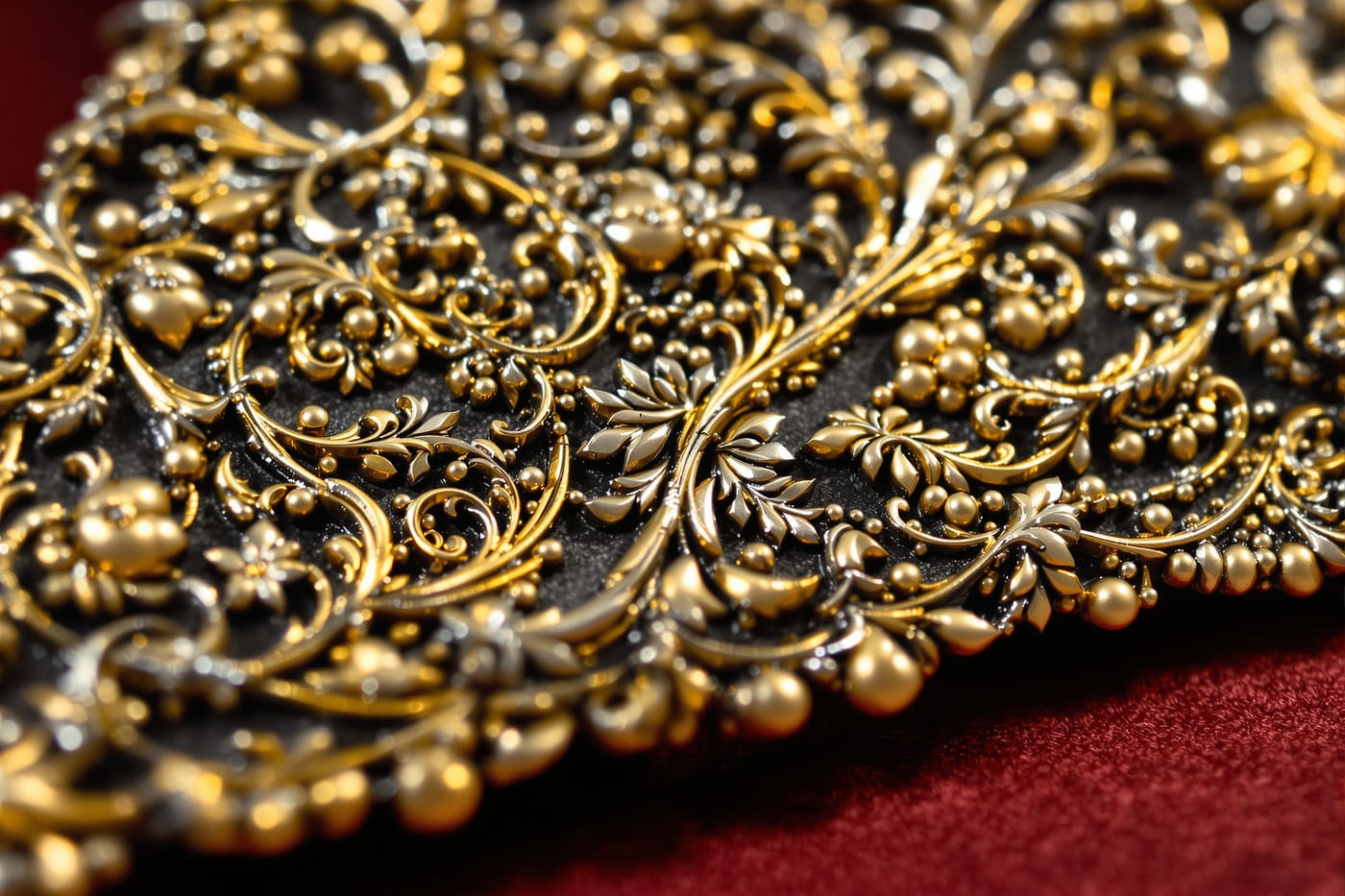
A monastic treasury is an accumulation rather than a curated display: objects given, commissioned or replaced across centuries and kept because they remained in use. The metalwork is dominated by silver and silver-gilt worked in repoussé and chasing, with filigree, niello and occasionally cloisonné enamel — reliquary caskets and cross-shaped containers, cast and hammered lamps, hanging tiers of lamps, chalices and patens, and the metal plaques applied to the covers of ceremonial books. The textiles include imported silks, gold-wrapped thread couched onto velvet grounds, and large embroidered cloths whose weave structure and thread can often be attributed to a particular production centre and period.
Handled as museum material, such objects are documented, analysed and stabilised rather than returned to newness. Alloys and gilding are identified by X-ray fluorescence, construction is read from tool marks and solder lines, and textiles are supported on dyed backing fabrics with reversible stitching, then displayed at low light levels and controlled humidity. Comparable pieces can be examined in published holdings such as those of the Getty Museum. The same methods of examination govern painted panels, described on our page on Byzantine iconography, and much of the furnishing recorded in medieval pilgrim accounts is known only from those written descriptions. Books and treasure alike were produced above all in the monasteries of the Judean desert.