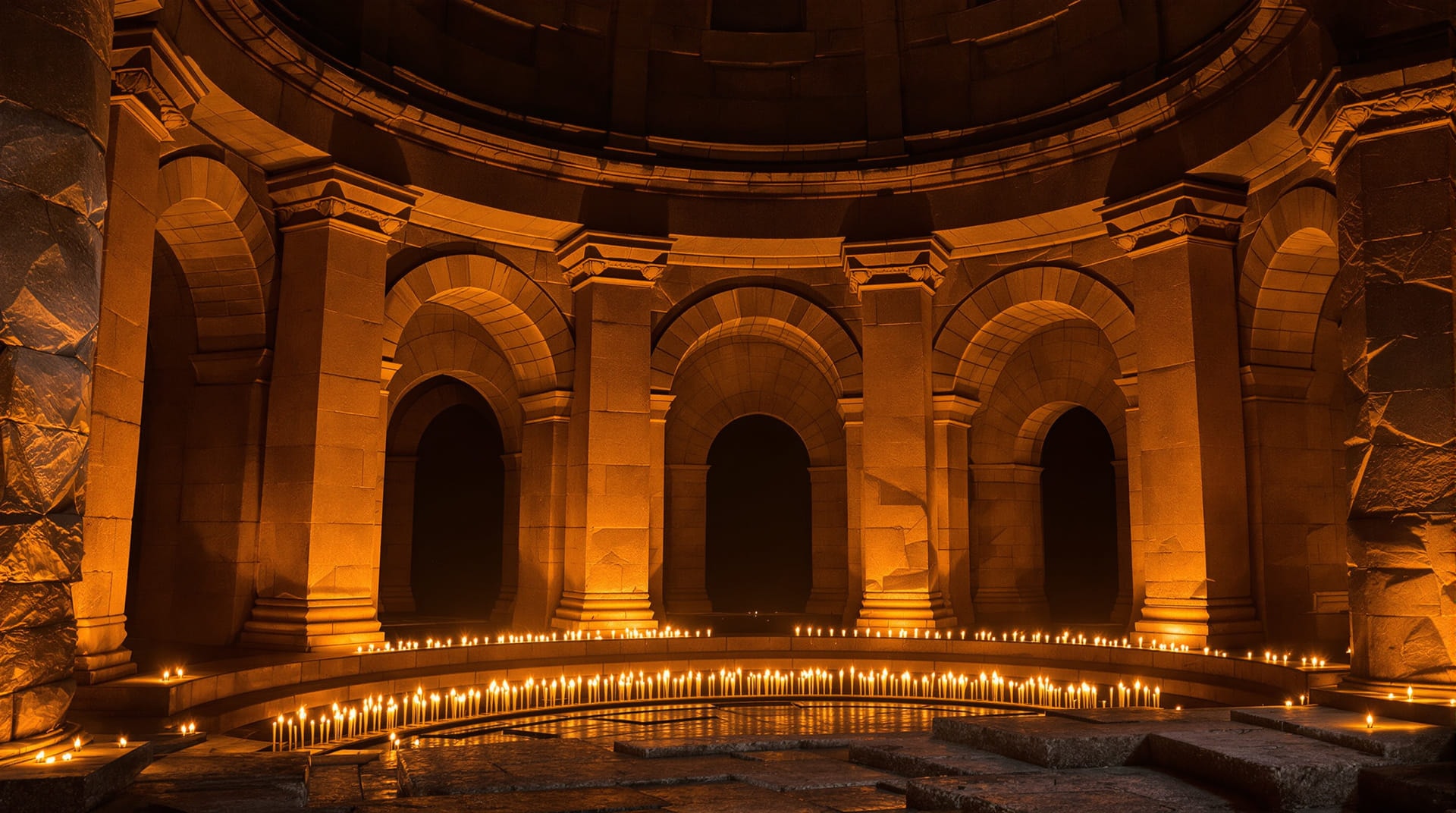
Few observances in the Christian East have left a longer written record than the ceremony kept on Holy Saturday inside the Church of the Holy Sepulchre, in the walled Old City of Jerusalem — the building known in Greek usage as the Church of the Resurrection, or Anastasis. The rite is called the Holy Fire, or more literally the Holy Light, and in outline it consists of the extinguishing of the lamps, the sealing of the chapel that encloses the tomb, a procession, the emergence of light, and the passing of flame through the congregation.
The approach taken here is historical and descriptive. Participants understand the rite in a particular devotional sense; sceptical accounts have also been recorded since the medieval period, and the question has never been settled by any account acceptable to all parties. What follows reports both rather than adjudicating between them. The building itself is treated on our page on the Church of the Holy Sepulchre.
Position within the sequence of Holy Week
The ceremony belongs to Holy Saturday, the day between the commemoration of the Crucifixion on Great Friday and the celebration of the Resurrection at Pascha. In the Orthodox reckoning that day carries a strong character of its own: the services dwell on the burial and on the descent into Hades, in a mood of expectant stillness rather than mourning. The imagery of darkness followed by a single flame multiplied through a crowd reads directly against the liturgical texts of the day.
Jerusalem's Holy Week has an unusually deep history of place-bound observance. The late fourth-century account associated with the pilgrim Egeria describes services moving between the sites of the events they commemorate: the Mount of Olives, the courtyard before the tomb, the rock of Golgotha. That stational pattern, visible in the late-antique sources gathered by the Internet Medieval Sourcebook, proved influential far beyond the city. The wider structure of the year is set out on our page on the liturgical calendar.
The written record from the ninth century onward
Attempts to trace the ceremony to the fourth century rest on ambiguous evidence. Egeria mentions lamps kindled at the tomb during the evening office, but lamp-lighting of that kind is an ordinary feature of Eastern vespers and is not presented as extraordinary. The earliest descriptions of a rite understood as the appearance of light are ninth-century: a Frankish traveller writing shortly after 867 gives a brief notice; Arabic-language historians of the tenth and early eleventh centuries record it as a well-known annual event; and a Byzantine letter of the mid-tenth century describes it in some detail.
From that point the notices run continuously. The complex was demolished in 1009 and reconstructed under Byzantine patronage in the 1040s, and the ceremony reappears across that break. It is described through the Crusader period, the Ottoman centuries, and the travel literature of the eighteenth and nineteenth centuries, which produced the most divergent descriptions on record.
How medieval pilgrims described it
Medieval pilgrim accounts remain the richest single body of evidence. The Rus' traveller Daniel, who journeyed to Jerusalem around 1106 and left one of the fullest early descriptions in any language, records the crowd waiting in the darkened rotunda, the lamps unlit, and the kindling he reports having witnessed. Latin, Italian, German and later Russian accounts repeat the same elements.
These writers differ sharply in tone. Some describe the event in frankly wondering terms; others set down what they saw with careful neutrality; a few express open doubt, and a papal letter of 1238 discouraged Latin participation. What the corpus establishes is the antiquity and popular importance of the observance rather than the nature of what occurred. The genre is discussed on our page on medieval pilgrim accounts.
The shape of the ceremony
The outward structure has been broadly stable since at least the medieval period, though details of vesture, route and personnel have changed. Descriptive accounts give its elements as follows.
- The oil lamps and candles of the church are extinguished, leaving the rotunda in near-darkness.
- The chamber of the tomb is inspected and its door sealed with wax, witnessed by representatives of the several Christian communities that maintain the building under a long-standing arrangement of defined areas and set service times.
- A procession circles the chapel of the tomb three times, accompanied by chanting.
- The senior officiating cleric of the Greek Orthodox community, having removed his outer vestments, enters the inner chamber; a representative of the Armenian Apostolic community remains in the outer chamber, the Chapel of the Angel.
- After an interval, flame is brought out through openings in the sides of the chapel.
The passing of the flame
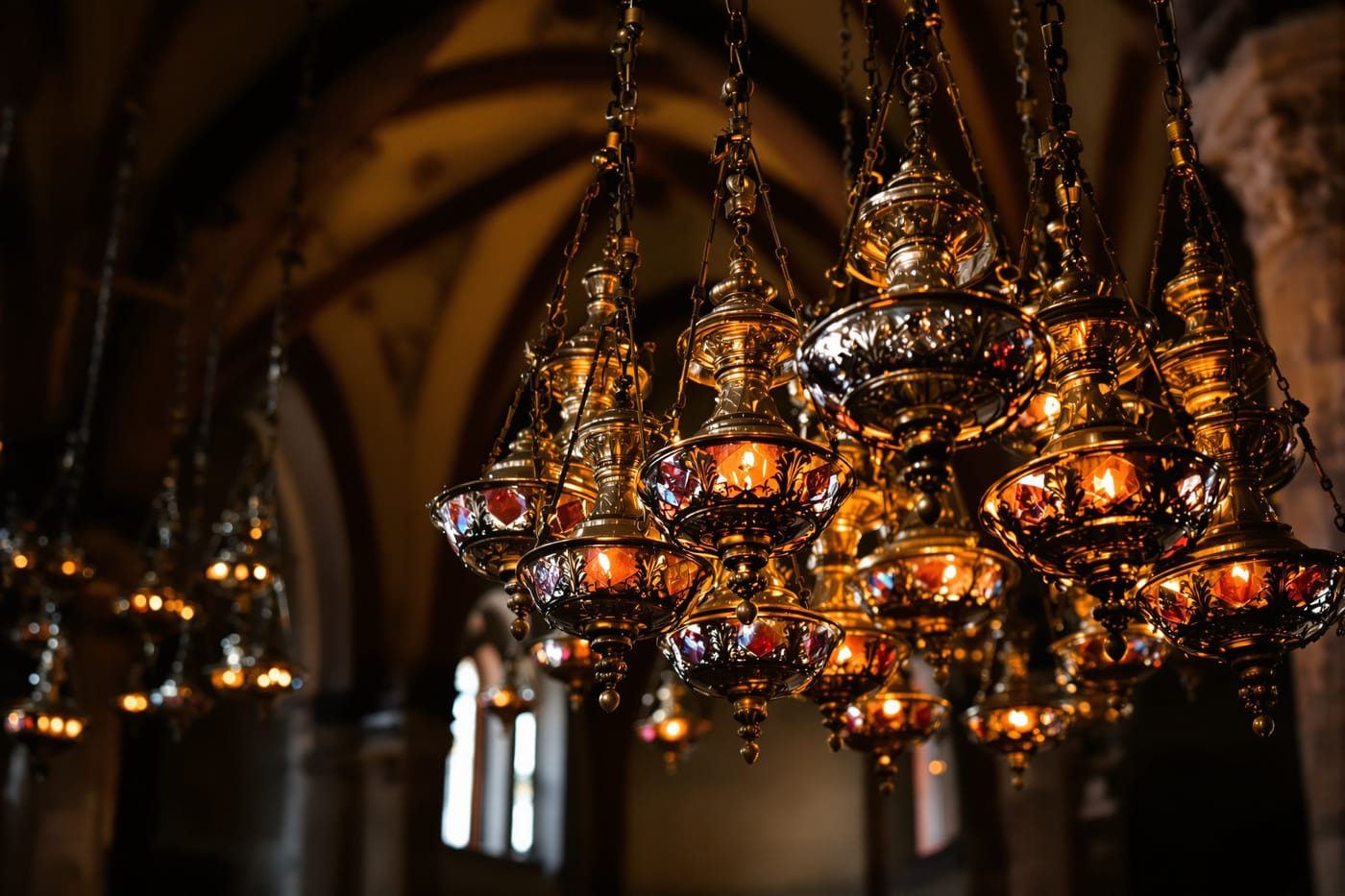
What follows is the part observers most often describe. The flame moves outward through the rotunda from hand to hand, bundle of tapers to bundle of tapers, until the darkened interior is filled with light within a very short time. The bundles are customarily of thirty-three tapers, a number participants associate with the traditional reckoning of Christ's years. Lamps are afterwards carried to the other communities in the building, and in modern practice flame is conveyed by air to Orthodox communities across the Balkans, the Caucasus and the Slavic lands.
Description, doubt, and an unsettled question
Sceptical accounts have been recorded since the medieval period, and the question has never been settled by any account acceptable to all parties. Doubt is not a modern innovation: it appears in Latin sources of the twelfth and thirteenth centuries, in a number of Eastern authors, and extensively in nineteenth-century European travel writing, where deflationary explanations sit alongside vivid descriptions of the crowd.
Set against this is an equally continuous body of testimony from participants, who understand the light as given rather than made, and for whom the observance ranks among the most significant events of the year. No investigation acceptable to every party has been conducted, and the sources do not permit a historian to settle the matter. What they do support is a clear account of what the rite consists of and of its antiquity.
The rite in the devotional imagination
Whatever view a reader takes, the ceremony has shaped Orthodox devotional culture far beyond Jerusalem. It has generated hymnography, iconography and a large body of vernacular narrative, and it helped keep the tomb a magnet for long-distance travel. General treatments of Eastern Orthodoxy and of the church that houses the tomb note its standing in that world, which is equally audible in the music described on our page on Byzantine chant.